Home › Blog › Small Business
Using an hmrc mileage claim calculator for self employed work is one of the quickest ways to lower your Self Assessment tax bill without digging through hundreds of faded petrol receipts. Under HMRC's flat-rate rules, sole traders and partners can claim a set pence-per-mile rate for every qualifying business journey instead of tracking fuel, servicing, and insurance separately. In this guide, you will see the current HMRC mileage rates (including the recent rise from the old 45p per mile rate to 55p per mile, plus upcoming changes from April 2027), how to calculate your deduction step by step, and what details your log must include.
Current HMRC simplified expenses mileage rates
HMRC calls its flat-rate vehicle method simplified expenses. Instead of working out the business percentage of your annual fuel, MOT, repairs, road tax, and vehicle depreciation, you multiply your total business miles for the tax year by HMRC's approved flat rates.
For many years, drivers were used to claiming 45p per mile for the first 10,000 miles. From 6 April 2026 (the 2026/27 tax year), HMRC raised that car and van rate to 55p per mile, and Budget 2026 confirmed that the rate for miles over 10,000 rises from 25p to 35p per mile from 6 April 2027.
| Vehicle type | Before 6 April 2026 (2025/26 return) | 2026/27 tax year (from 6 April 2026) | 2027/28 tax year (from 6 April 2027) |
|---|---|---|---|
| Cars and goods vehicles (first 10,000 business miles) | 45p per mile | 55p per mile | 55p per mile |
| Cars and goods vehicles (over 10,000 business miles) | 25p per mile | 25p per mile | 35p per mile |
| Motorcycles (all business miles) | 24p per mile | 24p per mile | 24p per mile |
Because HMRC can adjust these rates in future Budgets, make sure you apply the rate that matches the exact tax year in which you drove the miles. If you are filing your 2025/26 Self Assessment return (for trips driven between 6 April 2025 and 5 April 2026, due by 31 January 2027), you must still use the old 45p rate rather than 55p. Note that you can also claim separate business travel costs like congestion charges, bridge tolls, and parking fees on top of the flat mileage rate, provided the trip itself was wholly and exclusively for work.
Step-by-step: how to calculate your self-employed mileage claim
You can work out your total tax deduction in under five minutes once you have your annual business mileage figure ready.
- Separate business trips from personal driving. Count trips to client sites, wholesalers, banks, and temporary workplaces, while leaving out personal errands and regular commuting between home and a permanent base.
- Total your qualifying miles from 6 April to 5 April. Add up all business journeys completed within the single UK tax year you are filing for, as the 10,000-mile threshold resets every 6 April.
- Multiply the first 10,000 miles by the higher rate for that tax year. For the 2026/27 tax year, driving 8,400 business miles gives 8,400 multiplied by £0.55, which equals a £4,620 allowable expense (for 2025/26 trips at £0.45, the same distance equals £3,780).
- Multiply any remaining miles over 10,000 by the lower rate. For 13,000 business miles in 2026/27, the first 10,000 miles equal £5,500 at 55p and the extra 3,000 miles equal £750 at 25p, making £6,250 in total.
- Enter the final figure on your Self Assessment return. Add the total to your allowable business expenses so it reduces your taxable profit rather than coming directly off your tax bill.
What a compliant HMRC mileage log template needs
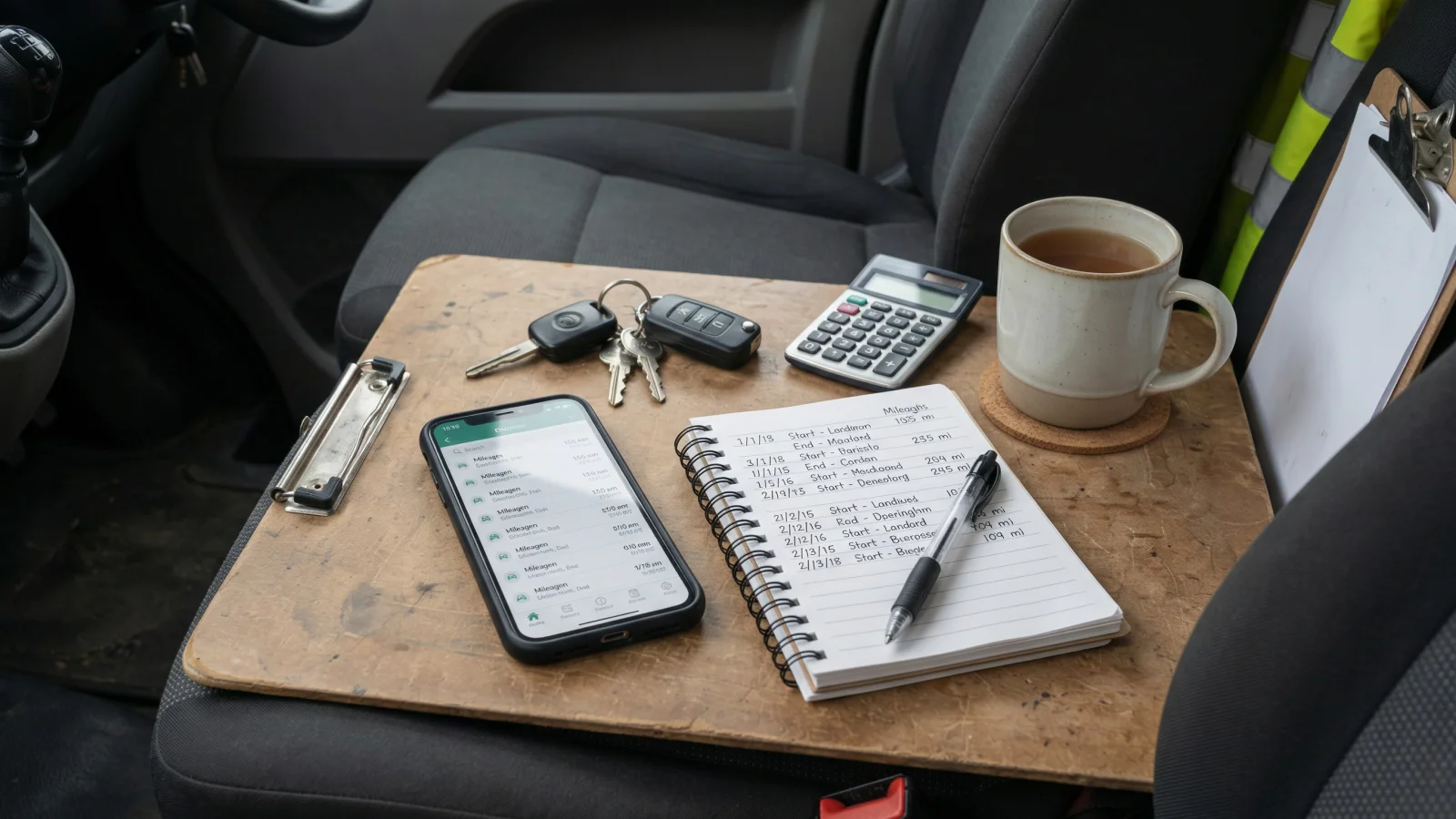
HMRC does not require a specific printed form, so a notebook, spreadsheet, or mobile tracker is fine as long as your records are accurate and recorded close to the time of travel. A reliable mileage log template should capture five clear columns for every business trip:
- Date of the journey: Confirms the trip took place inside the correct tax year and matches the right pence-per-mile rate.
- Start and finish postcodes: Shows HMRC where the journey began and ended, proving it was not personal travel.
- Purpose of the trip: A brief note such as "client boiler quote in Stockport" or "collecting timber from trade supplier."
- Vehicle used: Helpful if you switch between a personal car and a commercial van during the year, as HMRC counts all cars and vans together toward your 10,000-mile threshold.
- Total business miles: The round-trip or one-way distance for that specific work journey.
Keep your mileage logs safely for at least five years after the 31 January submission deadline of the relevant tax year, as HMRC can ask to inspect your records during a routine compliance check.
Logging work journeys on the road with Jis Mile
Scrawling postcodes onto scraps of paper on your dashboard or trying to rebuild twelve months of trips from Google Maps history in January is a recipe for missed deductions. Jis Mile gives self-employed drivers a fast, private way to log trips and see their running flat-rate claim total in real time. It is part of the pocketapps membership, which installs straight from your browser to your home screen with no app store download and no adverts.
You can record the date, start and destination postcodes, trip reason, and mileage as soon as you park up, and the app lets you check your cumulative deduction across the tax year even when HMRC updates its pence-per-mile rates. Because everything saves directly on your own device and works offline, you can log rural deliveries or underground car park visits with zero mobile signal, with optional encrypted sync if you also check your figures on a laptop at tax time.
Be clear on its limits before you start: Jis Mile is a manual mileage log and flat-rate claim calculator rather than a live GPS tracking app or registered tax agent. It does not run background GPS tracking while you drive or file your Self Assessment return directly with HMRC, so you enter your trip distances yourself and copy your final figure into your tax return or send the export to your accountant.
Simplified expenses vs actual vehicle costs
Once you choose simplified expenses for a vehicle, you must stick with that method for as long as you use that same vehicle in your business. You cannot switch back and forth between flat-rate mileage and actual running costs on the same car from one year to the next.
Actual costs, where you claim the business percentage of fuel, insurance, servicing, repairs, and capital allowances, can sometimes save more tax if you drive an expensive vehicle with high repair bills and low annual mileage. Tax rules around vehicle claims and capital allowances carry strict conditions, so always check the official rules on GOV.UK or speak with a qualified UK accountant before choosing your method.
Frequently asked questions
Is the HMRC mileage rate still 45p per mile?
No, HMRC increased the rate for cars and goods vehicles from 45p to 55p per mile for the first 10,000 business miles starting on 6 April 2026, with the rate above 10,000 miles rising from 25p to 35p from 6 April 2027. However, you must still use the old 45p rate for business miles driven before 6 April 2026 when filing your 2025/26 tax return, and always check GOV.UK in case future Budgets adjust the figures again.
Can I claim flat-rate mileage if I already claim fuel receipts?
No, the HMRC flat rate already covers fuel, servicing, tyres, road tax, insurance, and vehicle wear and tear. Claiming both flat-rate mileage and individual petrol receipts on your tax return counts as double-claiming and will be disallowed by HMRC.
Do self-employed drivers get paid the mileage rate back in cash from HMRC?
No, HMRC does not send you a cash payout for every mile driven. Instead, your total mileage claim is deducted from your business profits before income tax and National Insurance are calculated, reducing the overall tax bill you owe.
Can I claim mileage from my home to my regular workplace?
HMRC treats regular travel between your home and a permanent workplace as ordinary commuting, which cannot be claimed. However, if your home is genuinely your main business base and you travel out to temporary client sites or customer addresses, those business journeys usually qualify.
Start tracking every business mile today
Using an hmrc mileage claim calculator for self employed trips throughout the year ensures you apply the right HMRC rate for each tax year and never leave legitimate tax relief on the table when January arrives. At 55p a mile, every 100 forgotten business miles costs you £55 in missed expense deductions, so logging each journey as it happens pays off quickly.
If you want a simple, offline-ready logbook and deduction calculator on your phone, try Jis Mile or explore all 55 private tools on our apps page with a 7-day free trial.